
Need to understand your topic better?
Use the online encyclopedias or the history specific databases under the Start Research Guide.
Contextual information on a topic will give you topic synonyms and other information to search when doing research. For example, when you look up feminism in an encyclopedia, you'll see related terms under the topic, including "women's rights" or "women's suffrage". You will also find names of key figures, movements, and legislation in the history of feminism.
Find primary sources on our USLIB Primary Sources Guide page.
What is a primary source?
Primary sources are materials originating during the period you are studying. They include sources such as journal entries, artwork, newspaper articles, photos, and other items that reflect a firsthand experience or insights from a particular event or era.
Secondary sources are created by analysts, commentators, and reporters who evaluate primary sources to help other people better understand why a primary account is important." Academic journal articles and books (not autobiographies) are also usually secondary sources.
*If you need to ask a librarian, ask us @ usic@tas.edu.tw.
You can find scholarly research on the Next Level Research page or by using USIC Search.
Academic Journal Articles
Academic journal articles, also called scholarly periodical articles, are research articles that have been reviewed and written by experts in a field and are published in academic periodicals/journals. Watch the short video below for a clear definition.
Scholarly Books
Academic books are non-fiction (factual) books written by writers who have done in-depth research on the topic. The writer might be an academic, but sometimes is not. When reading scholarly books, make sure you read critically and that your author is not selectively using research to support their bias.
Practice:
To help establish connections between the historical and the current, use keyword linking as your search strategy.
When starting to explore during your research journey, read encyclopedias articles get a broad overview of your topic.
Note: General reference encyclopedias will not count towards your resource list (bibliography) for your History of Asia Research Paper. However, they can be used for general reference at the start of your research paper, to help you get a quick overview of your historical figure.
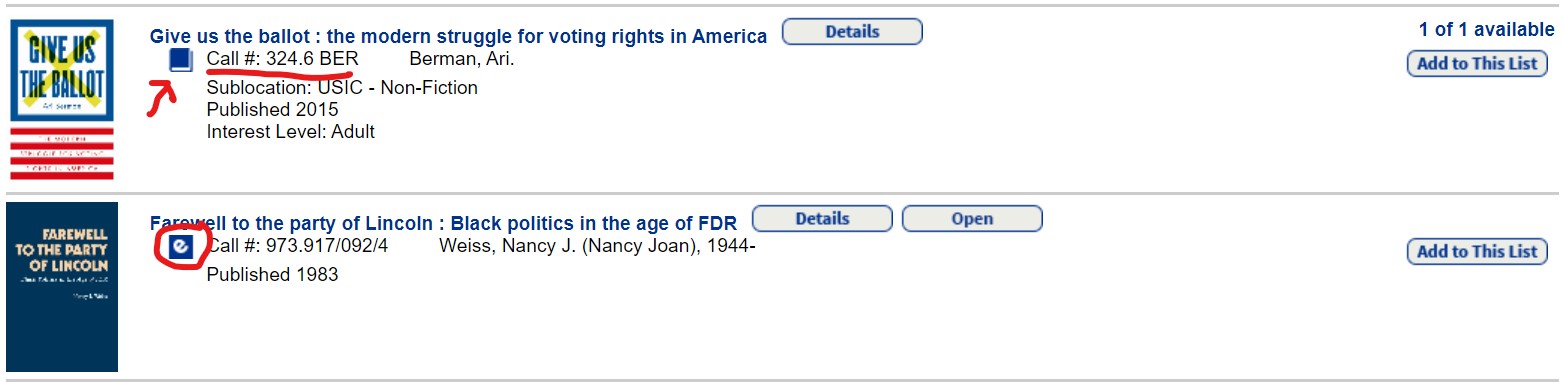
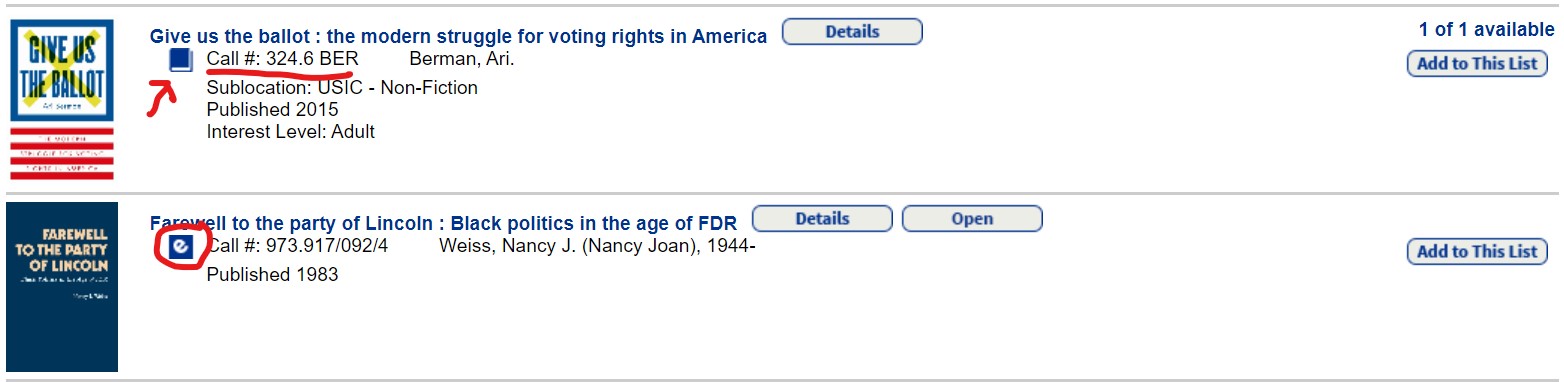
To find books and eBooks on our library catalog, go to the library homepage. Select Books & eBooks from our drop down menu in the search box. Write down the call number of the book you want and look for it on the shelf or cart.

Having difficulties finding books & ebooks in our library catalog?
A specialized search engine like SweetSearch is a great option for your history research because it emphasizes high-quality websites evaluated by teachers and librarians. The list below also features a couple of the largest library and museum websites with Asian history collections.
When you are further along in your research, you will start to read more in-depth academic articles on a specific aspect of your topic. Whenver you are not sure if a source counts as an academic journal article, get a quick overview of what to look for by reading this Guide to Recognizing Academic Sources. You may access articles via standalone (individual) databases or via Single Search as outlined below
This section contains materials to help you learn how to cite sources.
Accessing a Book or an eBook
Database Sources for Academic Articles and More!
Subject Encyclopedias
Useful History Resources
Our Research Guide lists helpful sites for Primary Sources.
What is the difference between primary and secondary sources?
This section contains materials to help you learn how to cite sources, recognize academic sources, and use resources such as Google Scholar to support your search for articles and ebooks.
Citing with AI Assistance:
HELPFUL DOCUMENTS
Citation Guides (Learn the rules)
A Note on When to Cite Generative AI (AI Chatbots such as Perplexity)
When you use AI to assist with your work, it’s important to give credit—just like you would with any other source. This section shows you how to properly cite AI tools. It covers the kinds of uses that students most find helpful. Always check with your teacher if you are unsure.
TAS AI Student Use Guide
AI Research Tools
Encyclopedia Databases
Academic Research Books (great for current and marginalized topics)
Free books on Internet Archives
If you can't find many books or eBooks
request that we purchase a new book on your topic under the services tab
Need a simplified or focused search environment?
Academic Search Complete - 1000s of scholarly journals, reports, and conference proceedings from most disciplines including science, math, and humanities.
Project Muse (Johns Hopkins) - abstracts, reviews, and links to 100s of journals in the humanities and social sciences.
Google Scholar - If we own an article and it is also indexed on Google Scholar, a blue link saying, "Taipei American School" appears to the right.
SweetSearch - The student's search engine, curated by teachers and librarians. A good place for marginalized topics and primary content such as news articles and archived images indexed by museums.
Primary Sources
Check out this page for tips and tricks on how to locate Primary Sources.
Not sure what a primary source is? Watch this video.
News Outlets
To search for historical topics that continue to have impact on current events, you may want to look at Newspapers and Current Events sources.
Pressreader: Many Newspapers and outlets covering international news. A great source for topics on Asia
Newsbank: International news.
The Diplomat: Strong US perspective on international news, politics, and affairs.
The NYTimes: American and international perspectives on world news (you must register for an account using @tas.edu.tw email).
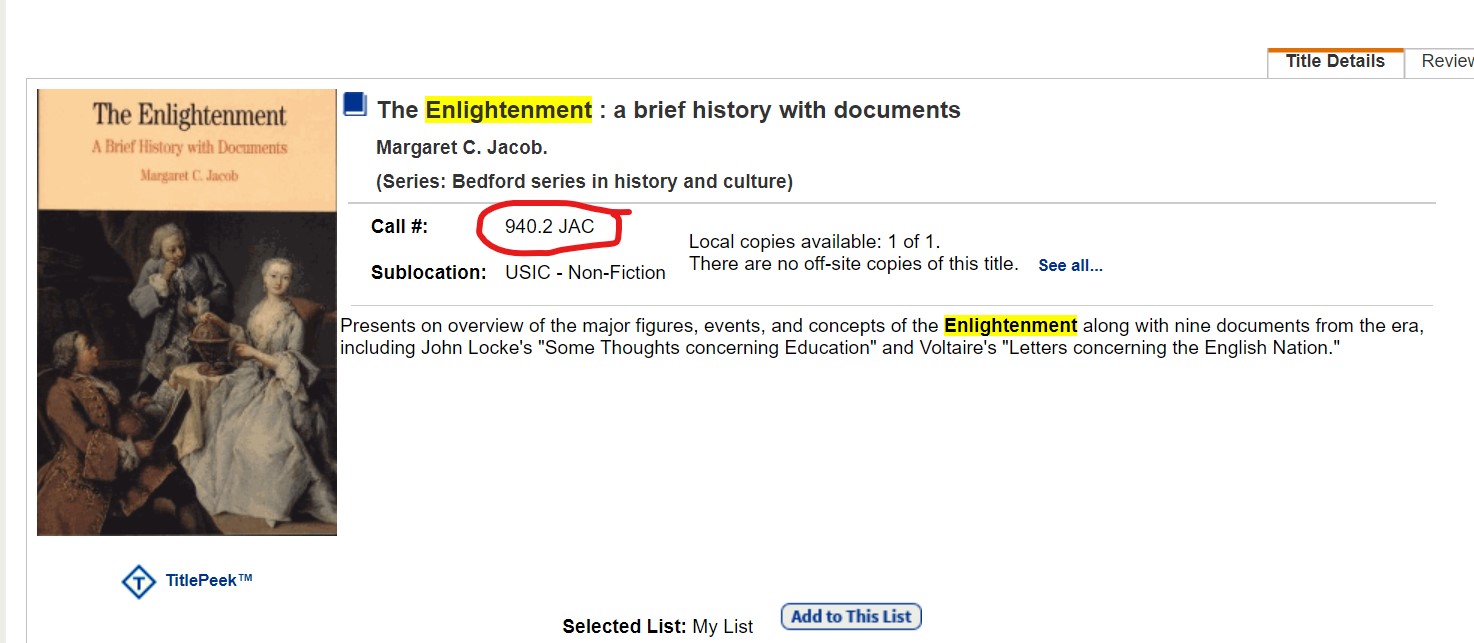
Here is a link to print and e-books on the Enlightenment.
Note: Print books for research assignments cannot be checked out as other students might need them. If you feel that your book is unique to your topic, and other students will not need your book, you may ask your teacher whether or not you can check it out.
Encyclopedias
Encyclopedias and reference books are books that have synthesized information on topics into shorter articles. Encyclopedias are a good starting point for background information on just about any topic. General encyclopedias are not acceptable sources for papers, but subject encyclopedias might be permitted.
Useful Subject Encyclopedias and other Reference Works
Useful e-Reference Subject Encyclopedias and other Reference Works
Other Academic e-Resources
For most databases, you can search with keywords including names of historical figures, places or events. Then use filters to limit your topics. Remember that the more keywords you search, the fewer results returned. Look for suggestions of search terms beneath the search box as you type.
Below are some recommended databases for finding academic journal articles in the humanities.
USIC Search also is a good place to find academic sources.
Using USIC Search, Databases, Books, eBooks +, and limiting to Full Text as well as Source Types to Academic Journals is a great place to begin researching for academic sources. Check out our guides on how to use the USIC Search and Google Scholar, or make an appointment with us if you need help.
Use our Next Level Research page for more information and a list of specifc databases that support academic research.
Questions about finding or using resources?
Ask Dr. Warrick or Ms. Wile. Make an appointment, email or stop by our offices.
Some Suggested Primary Source Resources
Check out our page of USIC primary resources.
Accessing a Book or an eBook
If you can't find many books or eBooks
Encyclopedias - Print and Digital
Print encyclopedias are in the USIC Reference shelves organized by call number. We also have history subject encyclopedias online.
Oxford Reference - Many subject encyclopedias on historical figures, countries, movements on a vast range oof topics including gender studies, history and more.
USIC Start Research Guide has additional subject encyclopedias. This guide has background sources for your topic and includes the below subject encyclopedias.
The USIC Next Level Research Guide is a great place to find academic journal articles and research books at school or at home.
USIC Search searches all of our resources including the below academic databases in every search.
If using USIC Search is overwhelming at first, check out our guide on how to use the USIC Search or search the below resources individually for your topic
Check out our USIC Primary Sources page for great tips and tricks to locating primary sources.
Not sure what a primary source is? Watch this video.
Cite your source! See our Citations Guide Chicago for instructions on how to cite primary and all other sources. Ask Dr. Warrick or Ms. Wile if you need help with citing!
Citing with AI Assistance:
Below is some information on how to cite AI. Like most style guides, the Chicago Manual of Style (CMOS has information on citing AI. (Google Chicago Manual and the words AI or ChatGPT.)
Chicago 17th from Chicago Manual of Style FAQ
As of March 2023, Chicago only requires a note and states that there is no bibliography format.
In-text citation or note
Format Number. Text generated by name of AI tool, Month Day, year, name of AI developer, URL.
Example 1. ChatGPT, response to “Explain how to make pizza dough from common household ingredients,” March 7, 2023, OpenAI. https://chat.openai.com/chat.
Example when prompt for text in paper: 1. Text generated by ChatGPT, March 7, 2023, OpenAI, https://chat.openai.com/chat.
The FAQ's of Citing AI in Academic Research - A Guide by Chicago Manual of Style Online
Q. How do you recommend citing content developed or generated by artificial intelligence, such as ChatGPT? Many scholarly publishers are requiring its identification though also requiring human authors to take responsibility for it and will not permit the AI to have “authorship.”
A. You do need to credit ChatGPT and similar tools whenever you use the text that they generate in your own work. But for most types of writing, you can simply acknowledge the AI tool in your text (e.g., “The following recipe for pizza dough was generated by ChatGPT”).
If you need a more formal citation—for example, for a student paper or for a research article—a numbered footnote or endnote might look like this:
1. Text generated by ChatGPT, OpenAI, March 7, 2023, https://chat.openai.com/chat.
ChatGPT stands in as “author” of the content, and OpenAI (the company that developed ChatGPT) is the publisher or sponsor, followed by the date the text was generated. After that, the URL tells us where the ChatGPT tool may be found, but because readers can’t necessarily get to the cited content (see below), that URL isn’t an essential element of the citation.
If the prompt hasn’t been included in the text, it can be included in the note:
1. ChatGPT, response to “Explain how to make pizza dough from common household ingredients,” OpenAI, March 7, 2023.
If you’ve edited the AI-generated text, you should say so in the text or at the end of the note (e.g., “edited for style and content”). But you don’t need to say, for example, that you’ve applied smart quotes or adjusted the font; changes like those can be imposed silently (see CMOS 13.7 and 13.8).
If you’re using author-date instead of notes, any information not in the text would be placed in a parenthetical text reference. For example, “(ChatGPT, March 7, 2023).”
But don’t cite ChatGPT in a bibliography or reference list unless you provide a publicly available link (e.g., via a browser extension like ShareGPT or A.I. Archives). Though OpenAI assigns unique URLs to conversations generated from your prompts, those can’t be used by others to access the same content (they require your login credentials), making a ChatGPT conversation like an email, phone, or text conversation—or any other type of personal communication (see CMOS 14.214 and 15.53).
[Editor’s update: Original answer updated to put the publisher before the date and to acknowledge tools like ShareGPT and A.I. Archives.]
To sum things up, you must credit ChatGPT when you reproduce its words within your own work, but unless you include a publicly available URL, that information should be put in the text or in a note—not in a bibliography or reference list. Other AI-generated text can be cited similarly.
Q. Robots are being named and even developing personalities, not just in fiction, but in the real world. Should their names be italicized—i.e., “I told Benjamin to wait at the coffee shop,” where Benjamin is a robot with artificial intelligence?
A. Italics for robot names could be fun in fiction; however, that doesn’t seem to be the convention either in fiction or in real life. (An exception is generally made for named spacecraft and the like, including the robotic Mars rover Perseverance; see CMOS 8.116.) Before you decide what to do, consider asking some robots to weigh in.
For some considerations on the use of AI in scholarly publishing and the responsibilities of authors, start with this position statement on authorship and AI tools from COPE (Committee on Publication Ethics). Here is the Statement. It provides links to other useful sources.
COPE position statement on Authorship and AI Tools: The use of artificial intelligence (AI) tools such as ChatGPT or Large Language Models in research publications is expanding rapidly. COPE joins organisations, such as WAME and the JAMA Network among others, to state that AI tools cannot be listed as an author of a paper. AI tools cannot meet the requirements for authorship as they cannot take responsibility for the submitted work. As non-legal entities, they cannot assert the presence or absence of conflicts of interest nor manage copyright and license agreements. Authors who use AI tools in the writing of a manuscript, production of images or graphical elements of the paper, or in the collection and analysis of data, must be transparent in disclosing in the Materials and Methods (or similar section) of the paper how the AI tool was used and which tool was used. Authors are fully responsible for the content of their manuscript, even those parts produced by an AI tool, and are thus liable for any breach of publication ethics. Related resources
First published: 13 February 2023 |
Want to learn More about ChatGPT and other chatbots? Who better to learn from about what Chatbots know than a CMOS Editor? Russell Harper, an Editor at CMOS, released an article on November 21, 2023, to bring awareness to Chat robots such as ChatGPT in academic research. The article is titled " What Do Chatbots Know?" and can be found by searching for the keywords "Artificial Intelligence" inside the Chicago Manual of Style Online
Content Source: Chicago Manual of Style Online, Accessed November 22-26, 2023
Did you know? TAS subscribes to Chicago Manual of Style Online. Think of this as the eBook version of the physical, print manual that you can borrow from the Upper School Library. Use Keyword searches as well as an extensive, up to date menu of contents to learn how to cite properly, and to correct citations that you have generated from databases.
Page updated January 28, 2024
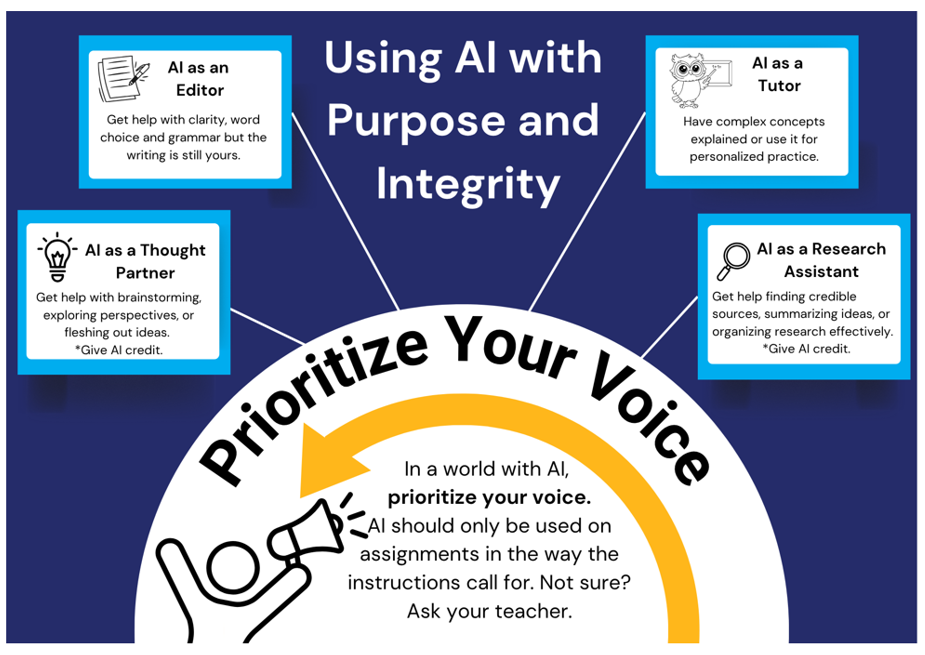
The Student Guide in the poster below is created by AI for Education to help you decide when it is appropriate to use AI for a project or homework. The section "Yes, but" tells you when AI can be a useful research tool. Always consult your teacher before using AI so as to ensure it helps you meet your learning goals. [Content on this page updated January 28, 2024]
Image courtesy of AI for Education aiforeducation.io Image updated January 16, 2024 at AI for Education.
Below is some information on how to cite AI. Like most style guides, the Chicago Manual of Style (CMOS has information on citing AI. (Google Chicago Manual and the words AI or ChatGPT.)
Chicago 17th from Chicago Manual of Style FAQ
As of March 2023, Chicago only requires a note and states that there is no bibliography format.
In-text citation or note
Format Number. Text generated by name of AI tool, Month Day, year, name of AI developer, URL.
Example 1. ChatGPT, response to “Explain how to make pizza dough from common household ingredients,” March 7, 2023, OpenAI. https://chat.openai.com/chat.
Example when prompt for text in paper: 1. Text generated by ChatGPT, March 7, 2023, OpenAI, https://chat.openai.com/chat.
The FAQ's of Citing AI in Academic Research - A Guide by Chicago Manual of Style Online
Q. How do you recommend citing content developed or generated by artificial intelligence, such as ChatGPT? Many scholarly publishers are requiring its identification though also requiring human authors to take responsibility for it and will not permit the AI to have “authorship.”
A. You do need to credit ChatGPT and similar tools whenever you use the text that they generate in your own work. But for most types of writing, you can simply acknowledge the AI tool in your text (e.g., “The following recipe for pizza dough was generated by ChatGPT”).
If you need a more formal citation—for example, for a student paper or for a research article—a numbered footnote or endnote might look like this:
1. Text generated by ChatGPT, OpenAI, March 7, 2023, https://chat.openai.com/chat.
ChatGPT stands in as “author” of the content, and OpenAI (the company that developed ChatGPT) is the publisher or sponsor, followed by the date the text was generated. After that, the URL tells us where the ChatGPT tool may be found, but because readers can’t necessarily get to the cited content (see below), that URL isn’t an essential element of the citation.
If the prompt hasn’t been included in the text, it can be included in the note:
1. ChatGPT, response to “Explain how to make pizza dough from common household ingredients,” OpenAI, March 7, 2023.
If you’ve edited the AI-generated text, you should say so in the text or at the end of the note (e.g., “edited for style and content”). But you don’t need to say, for example, that you’ve applied smart quotes or adjusted the font; changes like those can be imposed silently (see CMOS 13.7 and 13.8).
If you’re using author-date instead of notes, any information not in the text would be placed in a parenthetical text reference. For example, “(ChatGPT, March 7, 2023).”
But don’t cite ChatGPT in a bibliography or reference list unless you provide a publicly available link (e.g., via a browser extension like ShareGPT or A.I. Archives). Though OpenAI assigns unique URLs to conversations generated from your prompts, those can’t be used by others to access the same content (they require your login credentials), making a ChatGPT conversation like an email, phone, or text conversation—or any other type of personal communication (see CMOS 14.214 and 15.53).
[Editor’s update: Original answer updated to put the publisher before the date and to acknowledge tools like ShareGPT and A.I. Archives.]
To sum things up, you must credit ChatGPT when you reproduce its words within your own work, but unless you include a publicly available URL, that information should be put in the text or in a note—not in a bibliography or reference list. Other AI-generated text can be cited similarly.
Q. Robots are being named and even developing personalities, not just in fiction, but in the real world. Should their names be italicized—i.e., “I told Benjamin to wait at the coffee shop,” where Benjamin is a robot with artificial intelligence?
A. Italics for robot names could be fun in fiction; however, that doesn’t seem to be the convention either in fiction or in real life. (An exception is generally made for named spacecraft and the like, including the robotic Mars rover Perseverance; see CMOS 8.116.) Before you decide what to do, consider asking some robots to weigh in.
For some considerations on the use of AI in scholarly publishing and the responsibilities of authors, start with this position statement on authorship and AI tools from COPE (Committee on Publication Ethics). Here is the Statement. It provides links to other useful sources.
COPE position statement on Authorship and AI Tools: The use of artificial intelligence (AI) tools such as ChatGPT or Large Language Models in research publications is expanding rapidly. COPE joins organisations, such as WAME and the JAMA Network among others, to state that AI tools cannot be listed as an author of a paper. AI tools cannot meet the requirements for authorship as they cannot take responsibility for the submitted work. As non-legal entities, they cannot assert the presence or absence of conflicts of interest nor manage copyright and license agreements. Authors who use AI tools in the writing of a manuscript, production of images or graphical elements of the paper, or in the collection and analysis of data, must be transparent in disclosing in the Materials and Methods (or similar section) of the paper how the AI tool was used and which tool was used. Authors are fully responsible for the content of their manuscript, even those parts produced by an AI tool, and are thus liable for any breach of publication ethics. Related resources
First published: 13 February 2023 |
Want to learn More about ChatGPT and other chatbots? Who better to learn from about what Chatbots know than a CMOS Editor? Russell Harper, an Editor at CMOS, released an article on November 21, 2023, to bring awareness to Chat robots such as ChatGPT in academic research. The article is titled " What Do Chatbots Know?" and can be found by searching for the keywords "Artificial Intelligence" inside the Chicago Manual of Style Online
Content Source: Chicago Manual of Style Online, Accessed November 22-26, 2023
Did you know? TAS subscribes to Chicago Manual of Style Online. Think of this as the eBook version of the physical, print manual that you can borrow from the Upper School Library. Use Keyword searches as well as an extensive, up to date menu of contents to learn how to cite properly, and to correct citations that you have generated from databases.
Page updated January 28, 2024