Upper School Library
Joanna Nichols Memorial Libraries
Press enter or spacebar to select a desired language.

Classical Studies

Research in Classical Studies

INTRODUCTION

This Course Guide brings together resources to support your learning and research in Classical Studies, with a focus on Greek and Roman Studies and Latin. Explore TAS databases, library books and eBooks, and freely available online resources for classwork, independent study, and research.

Not sure where to start? Ask your Classical Studies teacher for guidance. TAS librarians can also help you find sources and develop effective search strategies. Click on this link to make an appointment with one of the Librarians


ABBREVIATIONS

Abbreviations are commonly used in Classical Studies to refer to ancient authors, works, journals, and other scholarly sources. You will become more familiar with them as your studies progress, but you do not need to memorize them. These guides are useful references you will likely return to often.


CITING SOURCES

Citing sources is an important part of academic research, and you will become more comfortable with it as you practice. For your Annotated Bibliography, Draft Essay, and Final Essay, use Chicago Manual of Style Author-Date formatting to cite your sources. We will review this style in class, and the guides below are useful references you can return to whenever you need help.

  • Chicago Manual of Style (CMOS) – TAS Authenticated link to the full-length CMOS manual.
  • CMOS Quick Guide – TAS Authenticated link to the CMOS Quick Guide. When you are first learning this formatting style, the quick guide is a good place to start. 

Language Dictionaries

Language dictionaries publish reliable information about words, people, places, things, and concepts. Use them regularly to learn how terms are correctly used in Classical Studies.

Oxford Classical Dictionary (OCD) The OCD contains short articles by field experts with references to further reading. TAS Online subscription is available. Your teacher has hardcopy in the classroom library and expects students to utilize this resource. 

Important Dictionaries for both Latin and Ancient Greek Aggregated by The University of Chicago

Thesaurus Lingua Graecae  Find more Lexica on this digital library of Greek Literature by the Thesaurus Linguae Graecae project.

Primary Sources

INTRODUCTION

What Are Primary Sources? 

Primary sources are those that are as close as possible to the event or phenomenon being studied. They represent the most direct evidence available. 

For Classical Studies, these can be: 

  • Textual - the literature produced during the historical period, or 
  • Artifactual - the (more) physical vestiges of the past, generally found and identified by archaeology. 

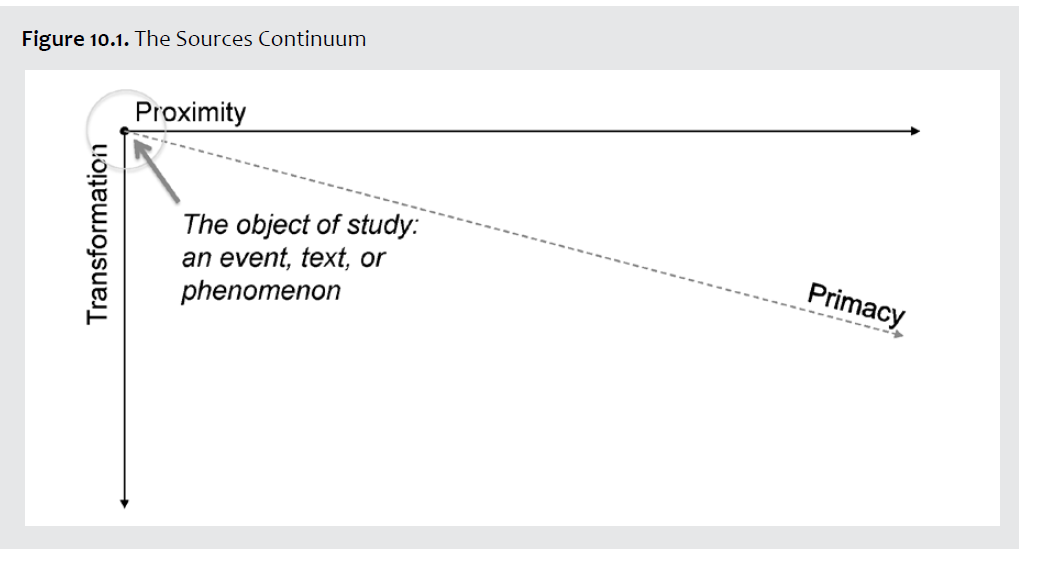
Primary sources are not all equally "primary." As Michael J. Paulus Jr. has explained in his writing, the primacy of a source is mediated by transformations it has undergone and the distance of the observer from the source in question. The graph below attempts to depict this relationship. 


he Sources Continuum: Degrees of Primacy. The primacy of a source is affected by its transformation and the observer’s distance from the original source. Adapted from Michael J. Paulus Jr., “What Is Primary? Teaching Archival Epistemology and the Sources Continuum” (2012).
Image: The Sources Continuum: Degrees of Primacy. The primacy of a source is affected by its transformation and the observer’s distance from the original source. Adapted from Michael J. Paulus Jr., “What Is Primary? Teaching Archival Epistemology and the Sources Continuum” (2012).


Examples of Primary Sources in classical Studies

ClassicWrites, a website maintained by Harvard University, cites the following examples of primary sources in Classical studies:

  • Greek and Latin texts in the original language or in translation (e.g., epic, tragedy, poetry, historical accounts, ancient novels, philosophical treatises, letters, etc.,).
  • Archaeological sites.
  • Archaeological artifacts and ancient art.
  • Inscriptions (e.g., tombstones, curse tablets, public monuments, graffiti and painted inscriptions, etc.,).
  • Coins.
  • Manuscripts and papyri.
  • Memoirs (common for reception studies).
  • Oral histories (common for reception studies).
  • Adaptations of ancient sources (e.g., plays, works of fiction) or a response in any form to ancient work (e.g., reaction essays, poetry, etc.) can be primary sources when working in reception studies.
  • Scholia: Scholia are grammatical, critical, or explanatory notes on ancient texts made by premodern authors; they can be separated from the works they address decades, centuries, or a millennium. Your specific project will determine if scholia are a primary or secondary source."

SELECTED ONLINE PRIMARY SOURCES

Classical Studies draws on many kinds of evidence. Use these specialized databases to explore texts, inscriptions, people, coins, art, and other material evidence relevant to your research.

This collection is not comprehensive. Depending on your research topic, your teacher may recommend additional resources.

Texts & Translations

  • Loeb Classical Library   Greek and Latin texts with accessible English translations. You may bookmark this TAS authenticated link to ensure you always have access to the full subscription database. 

Inscriptions & Epigraphy

  • Attic Inscriptions Online
    English translations of inscriptions from Athens and Attica, designed to make epigraphic evidence accessible to students.
  • Epigraphic Database Clauss-Slaby (EDCS)
    Search the world’s largest database of Roman inscriptions, with texts, dates, locations, and photographs or drawings for many records. An advanced resource for exploring inscriptions as primary evidence. Ask your teacher for assistance with searching tips and strategies when you first start exploring this database. 
  • Searchable Greek Inscriptions — Packard Humanities Institute
    A large searchable collection of Greek inscriptions in the original Greek. An advanced resource requiring knowledge of Greek epigraphy. 

People & Prosopography

  • Athenian Onomasticon
    Search people documented in ancient Athens and Attica by name, place, date, relatives, and other evidence. 
  • Digital Prosopography of the Roman Republic (DPRR)
    Explore prominent people of the Roman Republic, including their careers, offices, family relationships, status, and life dates. 
  • Prosopographia Imperii Romani (PIR)
    PIR is not itself a primary source but rather a tool that organizes and points you to people from the Roman Imperial period, including emperors and their families, senators, officials, writers, and other documented individuals. Draws on evidence from inscriptions, papyri, coins, and literary texts.

Coins & Numismatics

  • Online Coins of the Roman Empire (OCRE)
    Search Roman imperial coin types from Augustus through the late Roman Empire, with images and information on rulers, dates, mints, denominations, inscriptions, and imagery. 
  • Roman Provincial Coinage Online (RPC)
    Search coins minted in the provinces of the Roman Empire, with images and information about rulers, cities, inscriptions, designs, dates, and mints
  • acsearch.info — Ancient Coin Archive
    Search photographs and auction records of ancient coins, including descriptions useful for investigating coins as primary evidence (Note that this is an auction records resource. Compared to OCRE and RPC, it is less on the academic side. But it is still a good source of images & records of coins)

Art & Material Culture

  • Beazley Archive Pottery Database
    Search images and records of Greek pottery and vases by subject, artist, shape, and other characteristics—a major resource for studying visual and material evidence.

Archaeological Sites & Excavations

Explore archaeological sites through excavation records, photographs, artifacts, site reports, and other evidence made available by archaeological research projects. Many excavations now provide extensive digital archives that allow you to investigate both the site and the evidence recovered there.

  • Athenian Agora Excavations
    Search the American School of Classical Studies at Athens excavation records for the Athenian Agora, including artifacts, coins, photographs, plans, and other archaeological evidence.
  • Ancient Corinth Excavations
    Search excavation records and archaeological material from the American School of Classical Studies at Athens excavations at ancient Corinth.
  • iDAI.objects / Arachne
    Explore archaeological objects, photographs, excavation documentation, and archival collections from the German Archaeological Institute and collaborating institutions. 

PRINT PRIMARY SOURCES

  • In Rm 4B34 (World Languages Corridor) is a collection of translated primary source print materials.  Talk to your teacher for guidance about how best to utilize these important resources.


Secondary Sources

INTRODUCTION

What Are Secondary Sources?

Secondary sources analyze, interpret, or make arguments about primary sources and the past. They are usually produced after the period being studied and provide scholarly analysis and interpretation of the available evidence.

Secondary sources are an important part of research because they allow you to understand how scholars have interpreted primary sources, developed arguments, and contributed to our understanding of the classical world.

Examples of Secondary Sources in Classical Studies

ClassicWrites, a website maintained by Harvard University, cites the following examples of secondary sources in Classical Studies:

  • Books or monographs.
  • Scholarly articles, including reviews.
  • Commentaries, dictionaries, and other reference sources.
  • Archaeological site reports.
  • Other interpretative works.
  • Scholia: Scholia are grammatical, critical, or explanatory notes on ancient texts made by premodern authors; they can be separated from the works they address by decades, centuries, or a millennium. Your specific project will determine if scholia are a primary or secondary source.

An Important Note on Currency of Scholarship

For secondary scholarship published before approximately 1975, consult your teacher before investing significant time on the source. 


ONLINE SECONDARY SOURCES

Reference Databases  

Build your background knowledge and explore people, places, topics, and scholarship related to your research.

  • Cambridge Ancient History   In-depth reference articles on the history and cultures of the ancient world. Access provided by TAS. Access provided by TAS 
  • Database of Classical Scholars  Biographical and bibliographical information on scholars who have shaped the field of Classical Studies, including their careers, publications, and contributions to the discipline.  
  • Oxford Reference    Dictionaries and reference works covering people, places, terms, topics, and concepts. Access provided by TAS.

Scholarly Research Databases

Find scholarly articles, books, and other academic sources that provide analysis and perspectives related to your research.

  • JSTOR - Now Including Artstor  JTOR is a digital library of academic journals, books, and primary sources. You may search Artstor individually or use JSTOR’s unified search to access the same content. 
  • Project Muse  Provides abstracts and full text scholarly articles from over 120 universities and scholarly societies in the humanities and social sciences. 

Bibliographic Databases to Help You Find Scholarship

Use these specialized tools to discover books, articles, and other scholarship related to your topic.

  • Nestor A specialized bibliography for finding scholarship on Aegean studies, Homeric society, archaeology, and related topics. Includes scholarship published in multiple languages.
  • Zenon  A Multilingual catalog and bibliography for finding scholarship on archaeology, art, history, inscriptions, coins, and the ancient Mediterranean.

Book Reviews

Read scholarly reviews of books in Classical Studies to learn about a book’s focus, arguments, and contribution to the field.

  • Bryn Mawr Classical Review  BMCR contains free scholarly reviews of recent books on Greek and Roman studies, archaeology, ancient history, and related areas of Classical Studies.
  • Other places to find book reviews are JSTOR and Project Muse. Search for the book title and include the keywords "book review" in the search string. 

PRINT SECONDARY SOURCES

Consult your Classical Studies Teacher for guidance regarding currency of print secondary sources as well as how to access and use these materials. 

Secondary Sources - Scholarly Journals

INTRODUCTION

What are Scholarly Journals? 

Journals are an important type of secondary source in Classical Studies. They publish research and scholarly discussion about topics in the field.

Examples of Works Published in Scholarly Journals

  • Research articles presenting scholarly analysis, interpretations, and arguments
  • Book reviews evaluating recently published scholarship
  • Review articles discussing and comparing multiple works of scholarship
  • Notes or shorter studies examining specific texts, evidence, questions, or discoveries

INDIVIDUAL JOURNALS 

The following journals are available at TAS via databases such as JSTOR, Project Muse, and Cambridge Core. 

Acta Classica  An annual academic journal that covers all aspects of classical studies, including studies in ancient literature and history, as well as Patristic and Byzantine themes. Available at TAS via JSTOR and Project Muse databases.

Akropolis: Journal of Hellenic Studies This is an open access journal devoted to the study of Hellenic culture and civilization from antiquity to the present. More recent volumes available at TAS via Cambridge Core. Additionally, an archive of the journal can be accessed on JSTOR (The publisher has a 4-year publication embargo on the release of new volumes at JSTOR)

American Journal of Archaeology  The AJA publishes original research on the diverse peoples and material cultures of the Mediterranean and related areas, including North Africa (with Egypt and Sudan), Western Asia (with the Caucasus), and Europe, from prehistory through late antiquity and beyond.

American Journal of Philology  Quarterly academic journal covering the field of philology, and related areas of classical literature, linguistics, history, philosophy, and cultural studies.

Arethusa  Academic journal covering the field of Classics using an interdisciplinary approach incorporating contemporary theoretical perspectives and more traditional approaches to literary and material evidence.

Classical Antiquity  A biannual peer-reviewed academic journal that covers all topics pertaining to the field of classics, including Greek and Roman literature, history, archaeology, art, philosophy and philology, from the Bronze Age through Late Antiquity. 

Classical Journal   A quarterly peer-reviewed academic journal of classical studies. 

Classical Philology   A peer-reviewed academic journal covering all aspects of Graeco-Roman antiquity, including literature, languages, anthropology, history, social life, philosophy, religion, art, material culture, and the history of classical studies.

Classical World   A quarterly peer-reviewed academic journal focusing on Greek and Roman literature, history, traditions, as well as the history of classical scholarship. 

Gnomon   A German review journal covering the classics.

Harvard Studies in Classical Philology  A peer-reviewed academic journal covering topics in philology and classical studies, published annually.

Hermathena  A biannual peer-reviewed academic journal of the classical world. It was established in 1873 and is now one of the longest-running classical journals in the world.

Hermes A German periodical specializing in classical studies. 

Hesperia  A peer-reviewed journal published quarterly by the American School of Classical Studies at Athens. It was founded in 1932 for the publication of the work of the school. This is still the main aim of the journal today.

Historia: Zeitschrift für Alte Geschichte A peer-reviewed academic journal specializing in Greek and Roman antiquity. 

Mnemosyne   Mnemosyne is an academic journal of classical studies published by Brill Publishers. It was established in 1852 as a journal of textual criticism. It publishes articles mainly in English, but also in French, German, and Latin. 

Phoenix  An Open Access periodical/journal publishing papers that embody original research in all areas of classical studies: the literature, language, history, philosophy, religion, mythology, science, archaeology, art, architecture, and culture of the Greek and Roman worlds from earliest times to about AD 600. 

Transactions of the American Philological Association  Transactions of the American Philological Association (TAPA) is a peer-reviewed academic journal established in 1869 and the official publication of the Society for Classical Studies. It covers the history, culture, and language of ancient Greek and Roman societies. 

Vergilius  An annual peer-reviewed academic journal published by The Vergilian Society. The journal's primary focus is on works of Virgil, and, broadly speaking, classical studies, humanities, language, and literature.

 

Mapping Projects

Put Classical Studies on the Map: Explore the places, monuments, texts, and archaeological evidence of the Classical world through interactive mapping projects.
 
Ancient Olympic Games  Explore the sites, monuments, and landscape associated with the ancient Olympic Games.

Corinth Computer Project  Interactive maps and archaeological data tracing the planning and development of ancient Corinth.

Digital Augustan Rome c. 14 CE   Interactive map of Augustan Rome, with detailed information on buildings, monuments, and urban features.

ToposText  Ancient Places & Texts - Maps ancient Greek and Roman places and connects them to references in primary texts.

Karten von Attika  This Archaeological Map of Attica is interactive and visualizes a combination of archaeological remains, historical maps, and topographical data for ancient Attica.


Popular Blogs

Beyond The Textbook: Follow the Conversation and Learn What is Happening in Classical Studies: Explore blogs featuring discoveries, scholarship, digital projects, and contemporary perspectives across the field.

The Stoa: Digital Classics  News, reviews, projects, and developments in Digital Classics and digital approaches to Classical Studies. 

Rogue Classicism: Classics News & Resources  A curated roundup of news, discoveries, scholarship, and online resources related to Classics and archaeology. 

From the Archivist’s Notebook: Greece & Classical Archaeology  Essays inspired by archival research in Athens, exploring archaeology, Classical scholarship, modern Greece, and the people and institutions connected with them. 

Eidolon: Perspectives on Classics  Started as a blog, this is now an archive of essays connecting Classics with contemporary culture, politics, identity, and debates within the field. Eidolon was an active online Classics publication from 2015–2020.

Popular Podcasts

Listen In on Classical Studies: Hear scholars bring Classical Studies to life through conversations about history, archaeology, texts, people, and new research.

Byzantium & Friends: Byzantine History & Culture  Conversations with scholars about the history of Byzantium and related fields, hosted by historian Anthony Kaldellis. 

Lesche: Ancient Greece, New Ideas  Brown University professor Johanna Hanink talks with fellow Classicists about their latest research, books, and ideas in Greek Studies. 

Peopling the Past: People & Everyday Life  Conversations with scholars exploring archaeology, history, and everyday life, with a focus on the people who lived in Greece, Rome, Egypt, and the wider Mediterranean.