Upper School Library
Joanna Nichols Memorial Libraries
Press enter or spacebar to select a desired language.

Classical Studies

Research in Classical Studies

This page contains an introduction to research in Classical studies, information about citing sources, and key places to find abbreviation guides for when you write your paper or cite sources.  At the bottom of the page is a list of key dictionaries and reference sources that you will need for your studies and research. 

INTRODUCTION

The purpose of this research guide is to provide you with a general introduction to relatively easy to access research resources in the Classical Studies, with a focus on Greek and Roman Studies, as well as Latin. This is not a study guide but a list of databases that TAS subscribes to, books and eBooks you can borrow from the library, and freely available online resources to enrich your learning in class as well as support independent study and research. 

Whenever you are not sure which resource to use, reach out to your Classical Studies teacher for guidance.  The librarians can also help you locate sources and support your search strategies, especially when you start your research projects.  


ABBREVIATIONS

  • Abbreviations (for your Draft Essay): Citation of ancient material is a complicated tradition that goes back to the Hellenistic Period, the Library at Alexandria, and the development of writing and filing technologies (scroll, codex, and authorial curation). 
  • For ancient authors (e.g. Homer or Sophocles), you should follow the standardized abbreviations of the Oxford Classical Dictionary:

  • When conducting research and reading scholarship, you may find citations to abbreviated journal titles. Those abbreviations may be cross referenced with two major lists to find the full title of the journal or reference work. If you are not sure about a reference, you can always ask your teacher or librarian.


CITING SOURCES

  • For your Annotated Bibliography, Draft Essay, and Final Essay, it is important that you follow the citation style known as ‘Author Date’ in the Chicago Manual of Style. We will discuss this at length in class to clarify any questions you may have. The citation style guide below is comprehensive.
    • Chicago Manual of Style (CMOS) – TAS Authenticated link to the full CMOS manual 
    • CMOS Quick Guide – TAS Authenticated link to the quick guide. When you are first learning this formatting style, the quick guide is a good place to start. 


REFERENCE SOURCES 

  • In the collective fields that make up Classics, the aggregation of information is a fairly important activity that has occupied the last century of scholarly labor and production. Below are reference works you should know about when developing a Research Topic. You may only make use of some of these reference works at Hofstra University.


BOOK REVIEWS

In some cases, for undergraduate work, your teacher may not expect you to read an entire book(s) on your Research Topic. In other cases, you may want to know more about a book before you read it, i.e. which sections of the book are relevant to your Research Topic. The easiest way to find recent books on your topic is the Bryn Mawr Classical Review (BMCR).

  • Classical Review (BMCR)  The Byrn Mawr Classical Review (BMCR) contains reviews of new scholarly books in Classical Studies, including Greek and Roman history, literature, archaeology, and related fields.


ONLINE LANGUAGE DICTIONARIES

You may become interested in a specific word in an ancient author, and how it is used. The Logeion Project at University of Chicago aggregates a number of important dictionaries for both Latin and ancient Greek. Additional lexica can be found on the website of Thesaurus Lingua Graecae (TLG/TLL).

Primary Sources

This page begins with an introduction to primary sources in classical studies, followed by lists of online and print primary sources at the bottom of the page. 


Introduction: What Are Primary Sources? 

Primary sources are those that are as close as possible to the event or phenomenon being studied. They represent the most direct evidence available. 

For Classical Studies, these can be: 

  • Textual—the literature produced during the historical period, or 
  • Artifactual—the (more) physical vestiges of the past, generally found and identified by archaeology. 

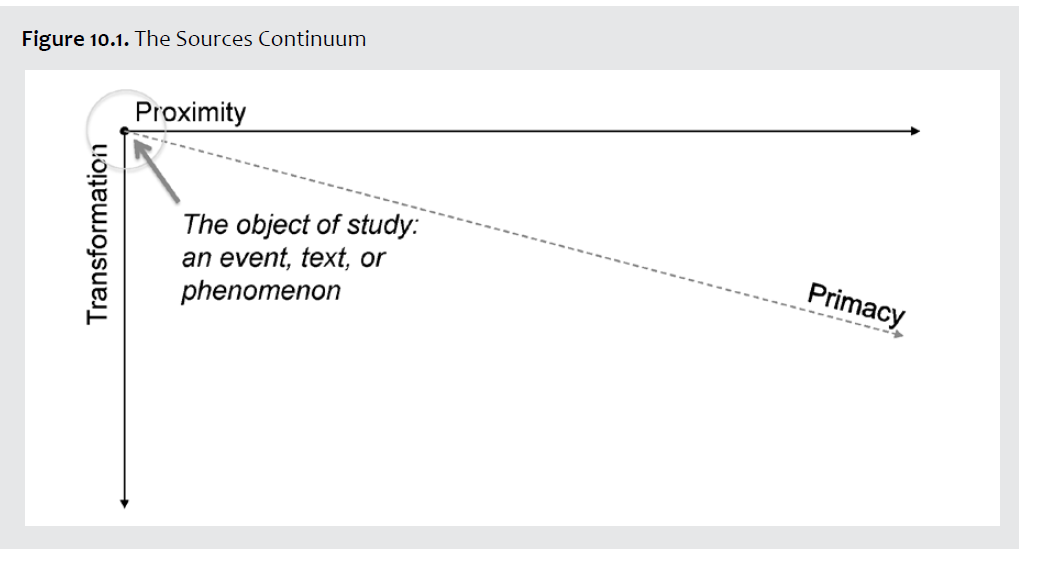
    Primary sources are not all equally "primary." As Michael J. Paulus Jr. has explained in his writing, the primacy of a source is mediated by transformations it has undergone and the distance of the observer from the source in question. See the graph below  attempts to depict this relationship. 

    he Sources Continuum: Degrees of Primacy. The primacy of a source is affected by its transformation and the observer’s distance from the original source. Adapted from Michael J. Paulus Jr., “What Is Primary? Teaching Archival Epistemology and the Sources Continuum” (2012).

    Image: The Sources Continuum: Degrees of Primacy. The primacy of a source is affected by its transformation and the observer’s distance from the original source. Adapted from Michael J. Paulus Jr., “What Is Primary? Teaching Archival Epistemology and the Sources Continuum” (2012). Click here to read the Full Text of Paulus Jr.'s article.


Harvard University's ClassicsWrites website, "A guide to research and writing in the field of Classics," describes how primary sources are viewed in the field of Classics or ancient history: 

"Primary sources provide firsthand evidence and/or testimony about a topic. From an investigative perspective, they are often created by witnesses who experienced an event themselves. In ancient writing there are sometimes authors, especially those we might classify as historians (e.g., Herodotus), who write about events that occurred in their own past, real or imagined (like mythology). Even though in this case the authors are not “first hand witnesses” to these events, we still consider the literary texts they produced to be primary sources, because their writing is a part of the cultural milieu it describes, and considered an 'insider' perspective. Primary sources are characterized by this insider nature, regardless of the medium, format, or genre. For that same reason the content of ancient texts is considered a primary source regardless of whether the language/words are reprinted in a modern book publication or located on the original papyrus or manuscript."

  • ClassicWrites cites the following examples of primary sources in Classics:
    • "Greek and Latin texts in the original language or in translation (e.g., epic, tragedy, poetry, historical accounts, ancient novels, philosophical treatises, letters, etc.)
    • Archaeological sites
    • Archaeological artifacts and ancient art
    • Inscriptions (e.g., tombstones, curse tablets, public monuments, graffiti and painted inscriptions, etc.)
    • Coins
    • Manuscripts and papyri
    • Memoirs (common for reception studies)
    • Oral histories (common for reception studies)
    • Adaptations of ancient sources (e.g., plays, works of fiction) or a response in any form to ancient work (e.g., reaction essays, poetry, etc.) can be primary sources when working in reception studies
    • Scholia: Scholia are grammatical, critical, or explanatory notes on ancient texts made by premodern authors; they can be separated from the works they address by decades, centuries, or a millennium. Your specific project will determine if scholia are a primary or secondary source."


Online Primary Sources

Classical Studies draws on many kinds of evidence. Use these specialized databases to explore texts, inscriptions, people, coins, art, and other material evidence relevant to your research.

This collection is not comprehensive. Depending on your research topic, your teacher or librarian may recommend additional specialized resources.

  • Texts & Translations
    • Loeb Classical Library
      Greek and Latin texts with accessible English translations. Always use the TAS authenticated link.

  • Inscriptions & Epigraphy
    • Attic Inscriptions Online
      English translations of inscriptions from Athens and Attica, designed to make epigraphic evidence accessible to students.
    • Epigraphic Database Clauss-Slaby (EDCS)
      Search the world’s largest database of Roman inscriptions, with texts, dates, locations, and photographs or drawings for many records. An advanced resource for exploring inscriptions as primary evidence. Ask your teacher for assistance with searching tips and strategies when you first start exploring this database. 
    • Searchable Greek Inscriptions — Packard Humanities Institute
      A large searchable collection of Greek inscriptions in the original Greek. An advanced resource requiring knowledge of Greek epigraphy. 

  • People & Prosopography
    • Athenian Onomasticon
      Search people documented in ancient Athens and Attica by name, place, date, relatives, and other evidence. 
    • Digital Prosopography of the Roman Republic (DPRR)
      Explore prominent people of the Roman Republic, including their careers, offices, family relationships, status, and life dates. 
    • Prosopographia Imperii Romani (PIR)
      PIR is not itself a primary source but rather a tool that organizes and points you to people from the Roman Imperial period, including emperors and their families, senators, officials, writers, and other documented individuals. Draws on evidence from inscriptions, papyri, coins, and literary texts.

  • Coins & Numismatics
    • Online Coins of the Roman Empire (OCRE)
      Search Roman imperial coin types from Augustus through the late Roman Empire, with images and information on rulers, dates, mints, denominations, inscriptions, and imagery. 
    • Roman Provincial Coinage Online (RPC)
      Search coins minted in the provinces of the Roman Empire, with images and information about rulers, cities, inscriptions, designs, dates, and mints
    • acsearch.info — Ancient Coin Archive
      Search photographs and auction records of ancient coins, including descriptions useful for investigating coins as primary evidence (Note that this is an auction records resource. Compared to OCRE and RPC, it is less on the academic side. But it is still a good source of images & records of coins)

  • Art & Material Culture
    • Beazley Archive Pottery Database
      Search images and records of Greek pottery and vases by subject, artist, shape, and other characteristics—a major resource for studying visual and material evidence.

  • Archaeological Sites & Excavations: Explore archaeological sites through excavation records, photographs, artifacts, site reports, and other evidence made available by archaeological research projects. Many excavations now provide extensive digital archives that allow you to investigate both the site and the evidence recovered there.
    • Athenian Agora Excavations
      Search the American School of Classical Studies at Athens excavation records for the Athenian Agora, including artifacts, coins, photographs, plans, and other archaeological evidence.
    • Ancient Corinth Excavations
      Search excavation records and archaeological material from the American School of Classical Studies at Athens excavations at ancient Corinth.
    • iDAI.objects / Arachne
      Explore archaeological objects, photographs, excavation documentation, and archival collections from the German Archaeological Institute and collaborating institutions.


Print Primary Sources 

  • In Rm 4B34 (World Languages Corridor) is a collection of translated primary source print materials.  Talk to your teacher for guidance about how best to utilize them.


Secondary Sources

ONLINE SECONDARY SOURCES

  • Subscription Databases 
    • one
    • two 
    • three


  • Freely available Online Secondary Sources
    • one
    • two 
    • three


PRINT SECONDARY SOURCES


Mapping Projects

Put Classical Studies on the Map: Explore the places, monuments, texts, and archaeological evidence of the Classical world through interactive mapping projects.


Popular Blogs

Beyond The Textbook, Follow the Conversation and Learn What is Happening in Classical Studies: Explore blogs featuring discoveries, scholarship, digital projects, and contemporary perspectives across the field.

The Stoa: Digital Classics
News, reviews, projects, and developments in Digital Classics and digital approaches to Classical Studies. 

Rogue Classicism: Classics News & Resources
A curated roundup of news, discoveries, scholarship, and online resources related to Classics and archaeology. 

From the Archivist’s Notebook: Greece & Classical Archaeology
Essays inspired by archival research in Athens, exploring archaeology, Classical scholarship, modern Greece, and the people and institutions connected with them. 

Eidolon: Perspectives on Classics
Started as a blog, this is now an archive of essays connecting Classics with contemporary culture, politics, identity, and debates within the field. Eidolon was an active online Classics publication from 2015–2020.

Popular Podcasts

Listen In on Classical Studies: Hear scholars bring Classical Studies to life through conversations about history, archaeology, texts, people, and new research.